
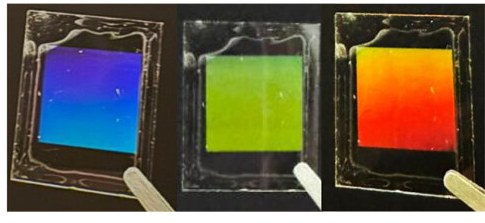
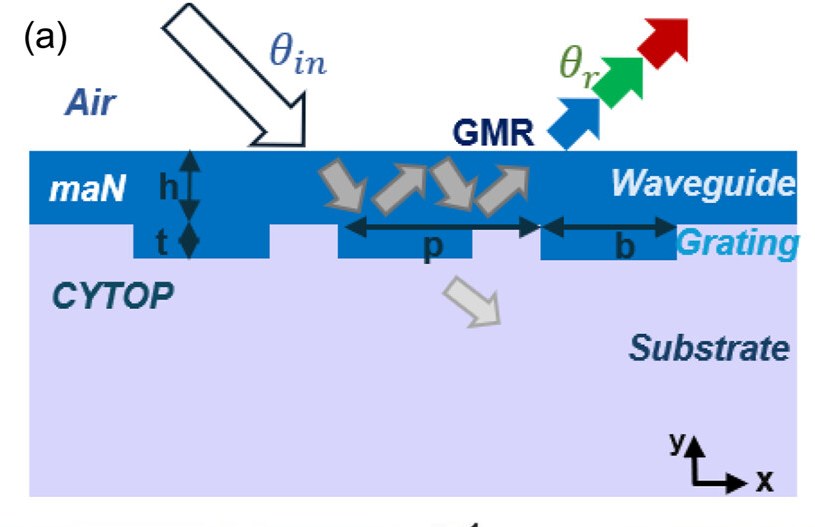
Augmented-reality (AR) glasses need an optical combiner: a transparent element that overlays digital images on the real world. It must reflect only the colours of the projected image, let everything else through, and be thin, light and cheap enough for everyday eyewear. Nanostructured gratings can do this, but they are usually made with slow, costly lithography and left exposed to dust, scratches and humidity.
What is new
- A fully polymeric and transparent guided-mode resonant (GMR) metagrating designed for visible light.
- An encapsulated architecture: the grating is buried at the interface between the substrate and the waveguide, so it is protected from the environment without losing its optical function.
- A scalable fabrication route based on thermal nanoimprint lithography: the pattern is stamped into a low-index fluoropolymer (CYTOP) and then backfilled with a high-index resist.
Key results
- SEM and AFM show faithful pattern transfer, uniform structures and excellent reproducibility across independently fabricated samples.
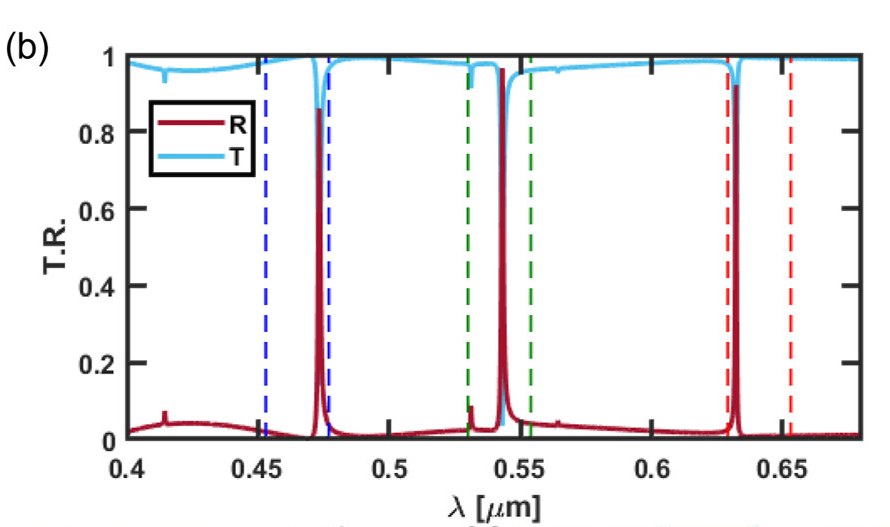
- Three sharp resonances appear close to the target blue, green and red wavelengths, in good agreement with RCWA simulations.
- Under white light the samples reflect blue, green or red depending on the viewing angle, as predicted by design.
Impact & outlook
The work shows that nanoimprint lithography is a robust, low-cost and scalable way to produce transparent metagratings over large areas. This opens the way to lightweight AR combiners for consumer electronics and for assistive and healthcare applications, such as support for older adults or people with cognitive impairments. The research was carried out with LAAS-CNRS (Toulouse) and C2N-CNRS (Palaiseau).
Reference: F. Filograno, O. Gauthier-Lafaye, A. Laborde, J.-B. Doucet, V. Raimbault, N. Bardou, B. Dagens, G. Calò, G. Magno, “A Scalable Large-Area Fabrication Strategy for Transparent Polymeric Encapsulated Metagratings,” Nanophotonics (2026). doi:10.1002/nap2.70224