
nPEG works on the analysis, design, fabrication and characterization of electromagnetic devices from microwave to optical frequencies. Our activities are organised in two research areas – Photonics and Microwaves & Antennas – supported by numerical modelling and by optical and RF/microwave laboratories at DEI, Politecnico di Bari. Click on an image to open the related publication.
Photonics
Integrated photonics
Design and characterization of integrated photonic components and circuits, from couplers and filters to photonic crystal cavities, lithium niobate devices, non-reciprocal components and graphene-assisted absorbers.
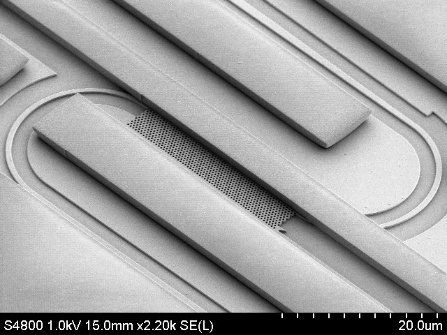
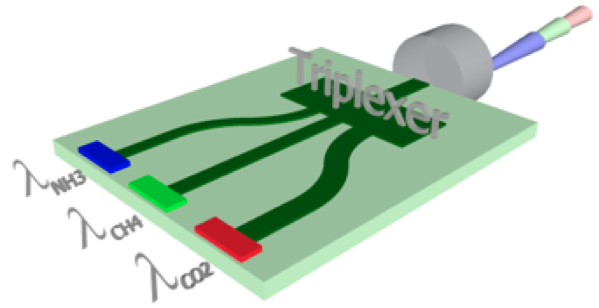
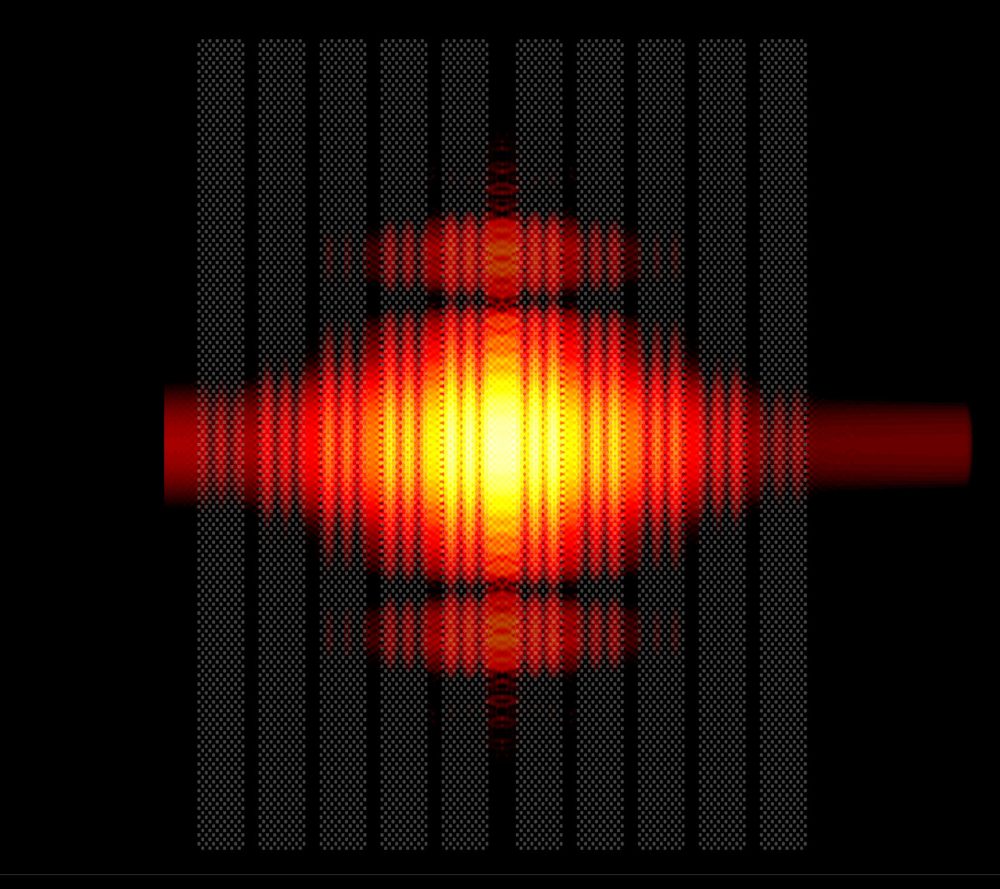
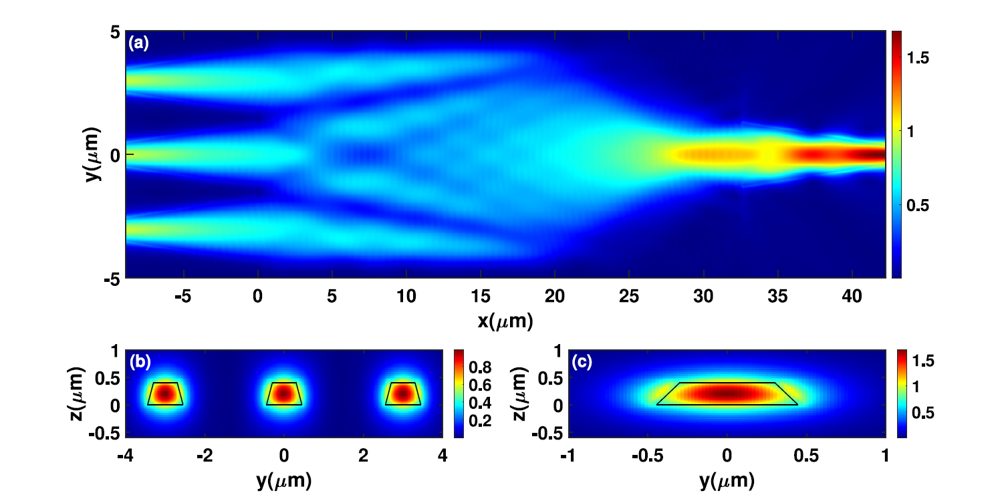
Related publications
- Ajmal Thottoli, Gabriele Biagi, Artem S. Vorobev, Marilena Giglio, Giovanni Magno, Liam O’Faolain, Marco Grande, “Highly efficient and selective integrated directional couplers for multigas sensing applications”, Scientific Reports, vol. 13, no. 1, 2023.
- Ajmal Thottoli, Gabriele Biagi, Artem S. Vorobev, Antonella D’Orazio, Giovanni Magno, Liam O’Faolain, “Cascaded Directional Coupler-Based Triplexer Working on Spectroscopically Relevant Wavelengths for Multiple Gas Detection”, Photonics, vol. 12, no. 3, 2025.
- G. Magno, A. Monmayrant, M. Grande, F. Lozes-Dupuy, O. Gauthier-Lafaye, G. Calò, V. Petruzzelli, “Stable planar mesoscopic photonic crystal cavities”, Optics Letters, vol. 39, no. 14, 2014.
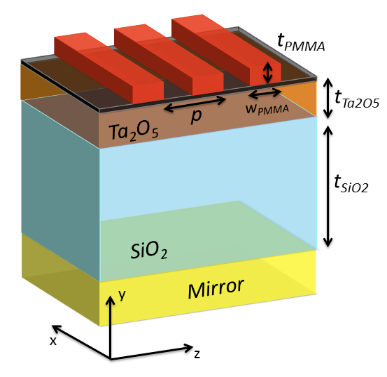
- Pezhman Yousefi, Muhammad Khalid, Vincenzo Petruzzelli, Giovanna Calò, “Multi-channel add-drop filter using superimposed gratings in hybrid SiN-TFLN platform”, Optics Communications, vol. 591, 2025.
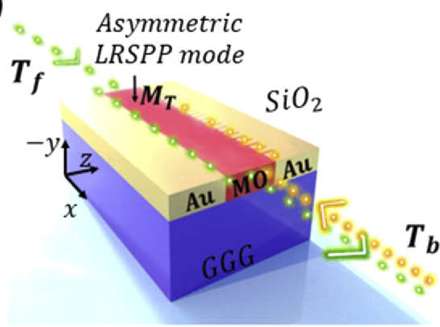
- SEVAG ABADIAN, GIOVANNI MAGNO, VY YAM, BEATRICE DAGENS, “Broad-band plasmonic isolator compatible with low-gyrotropy magneto-optical material”, Optics Express, vol. 29, no. 3, 2021.
- M. Grande, M. A. Vincenti, T. Stomeo, G. V. Bianco, D. De Ceglia, N. Aközbek, V. Petruzzelli, G. Bruno, M. De Vittorio, M. Scalora, A. D’Orazio, “Graphene-based perfect optical absorbers harnessing guided mode resonances”, Optics Express, vol. 23, no. 16, 2015.
- Photonic components – directional couplers, duplexers/triplexers and filters for multi-gas sensing in the near- and mid-infrared.
- Photonic crystals – planar mesoscopic cavities and spatial dispersion engineering.
- Lithium niobate – linear and nonlinear devices on thin-film lithium niobate (LNOI / hybrid SiN–TFLN) platforms.
- Non-reciprocal devices – magneto-plasmonic isolators compatible with low-gyrotropy magneto-optical materials.
- Graphene and phase-change materials – guided-mode-resonance absorbers and reconfigurable integrated devices.
Metasurfaces & plasmonics
Dielectric and plasmonic metasurfaces for sensing and augmented reality, plasmonic nanostructures for colour control, optical tweezers and neural implants, and integrated nanoantennas for on-chip optical wireless communication.
Related publications
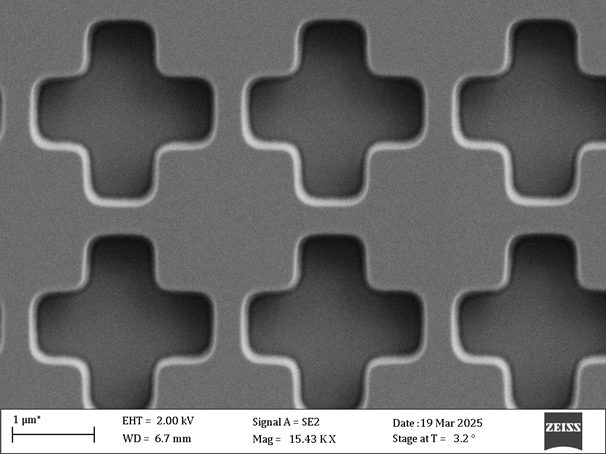
- Tomasz Piwonski, Giovanni Piscopo, Jesus Hernan Mendoza-Castro, Artem S. Vorobev, Antonella D’orazio, Giovanni Magno, Liam O’faolain, “Metasurface-Enhanced Mid-Infrared Sensing for High Sensitivity Detection of Gases and Liquids”, International Conference on Transparent Optical Networks, 2025.
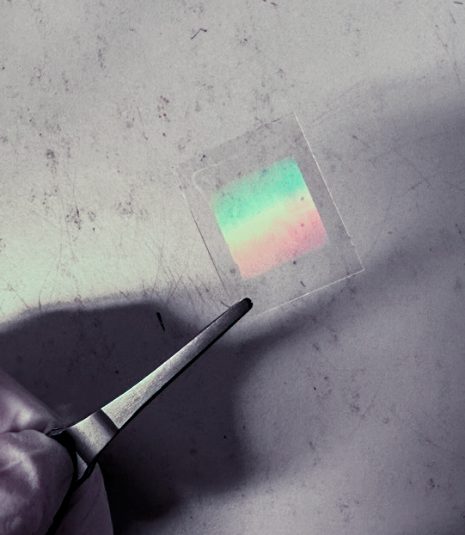
- Giovanni Magno, Béatrice Dagens, Antonella D’Orazio, Olivier Gauthier-Lafaye, “Multi-colour reflective metagrating with neutral transparency for augmented reality”, Optics Express, vol. 32, no. 15, 2024.
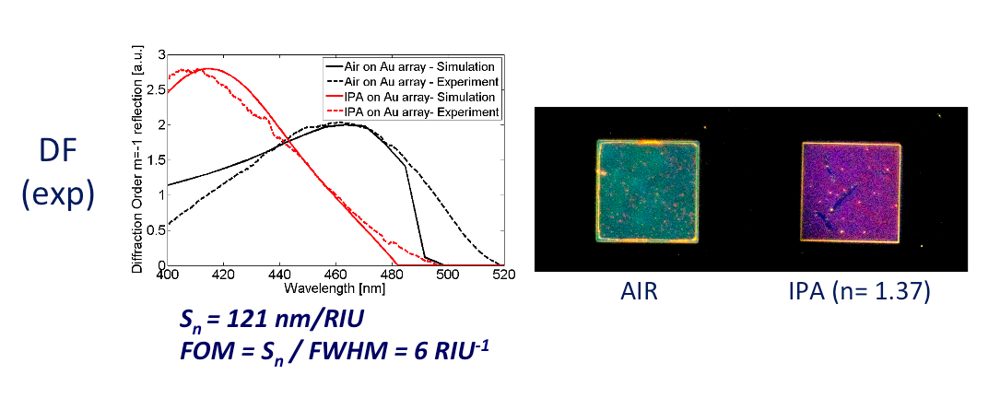
- M. A. Vincenti, M. Grande, D. De Ceglia, T. Stomeo, V. Petruzzelli, M. De Vittorio, M. Scalora, A. D’Orazio, “Color control through plasmonic metal gratings”, Applied Physics Letters, vol. 100, no. 20, 2012.
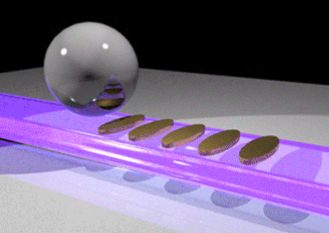
- Giovanni Magno, Aurore Ecarnot, Christophe Pin, Vy Yam, Philippe Gogol, Robert Mégy, Benoit Cluzel, Béatrice Dagens, “Integrated plasmonic nanotweezers for nanoparticle manipulation”, Optics Letters, vol. 41, no. 16, 2016.
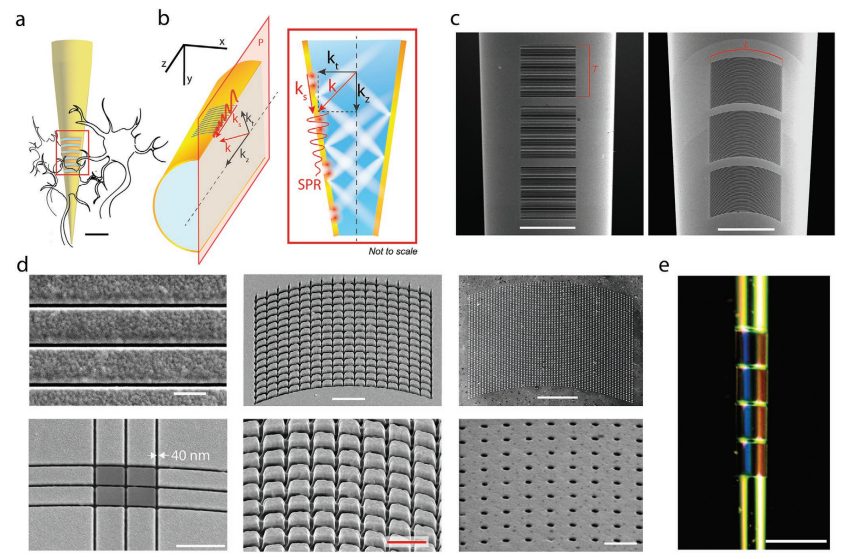
- Filippo Pisano, Liam Collard, Muhammad Fayyaz Kashif, Antonio Balena, Marco Pisanello, Di Zheng, Francesco De Angelis, Marco Grande, Cristian Ciracì, Massimo De Vittorio, Ferruccio Pisanello, “Augmented optical neural implants using plasmonic nanomodulators integrated on multimode fibers”, Bio Optics Design and Application in Proceedings Biophotonics Congress Optics in the Life Sciences 2023 Oma NTM Boda Omp Brain 2023, 2023.
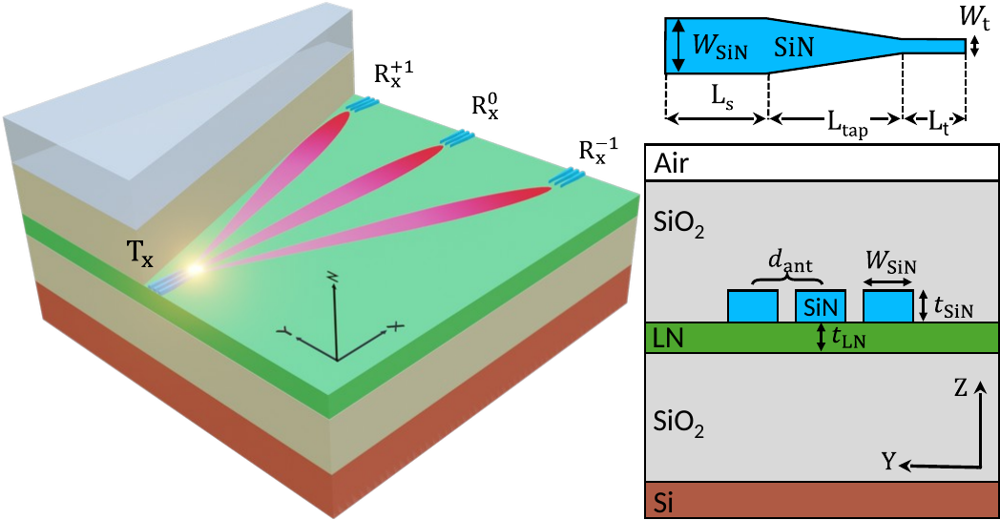
- Muhammad Khalid, Simone Ferraresi, Gaetano Bellanca, Marina Barbiroli, Franco Fuschini, Velio Tralli, Davide Bertozzi, Vincenzo Petruzzelli, Giovanna Calò, “LNOI Wireless Switches Based on Optical Phased Arrays for On-Chip Communication”, IEEE Journal on Selected Areas in Communications, vol. 42, no. 8, 2024.
- Metasurfaces for sensing – mid-infrared metagratings and BIC metasurfaces for high-sensitivity detection of gases and liquids.
- Augmented reality – transparent multi-colour metagratings and metalenses for AR displays.
- Plasmonics – colour control with metal gratings, integrated nanotweezers for trapping and thermal manipulation, plasmonic nanomodulators on fibre-based neural implants.
- Integrated nanoantennas – optical phased arrays and wireless switches for on-chip communication.
Microwaves & Antennas
Antennas, RIS & metasurfaces
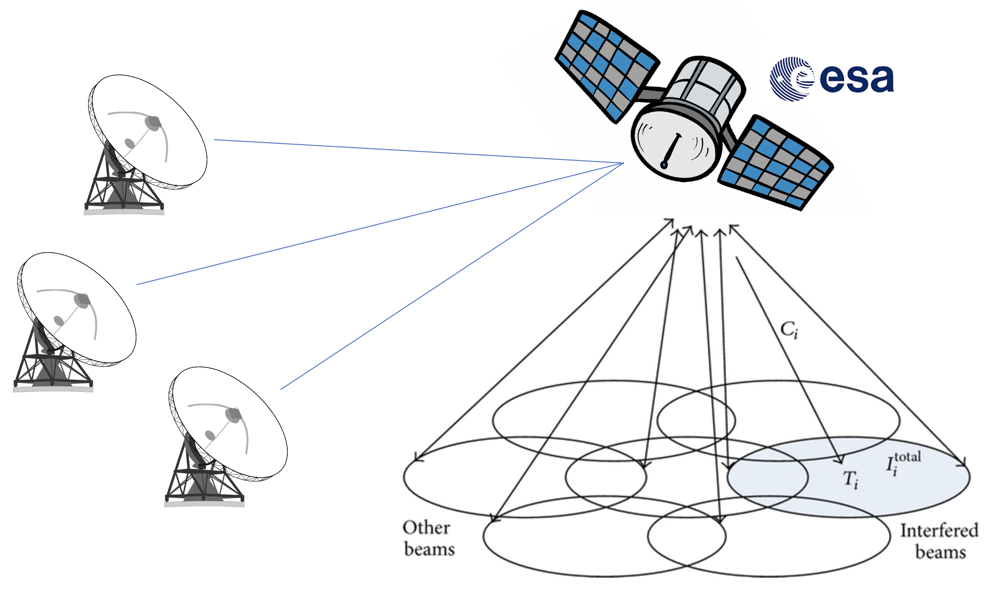
Graphene-based RF/microwave devices and transparent antennas, 3D-printed dielectric resonator antennas, design, fabrication and characterization of X-band reconfigurable intelligent surfaces (RIS) and metasurfaces, and computational tools for terrestrial and non-terrestrial communications.
Related publications
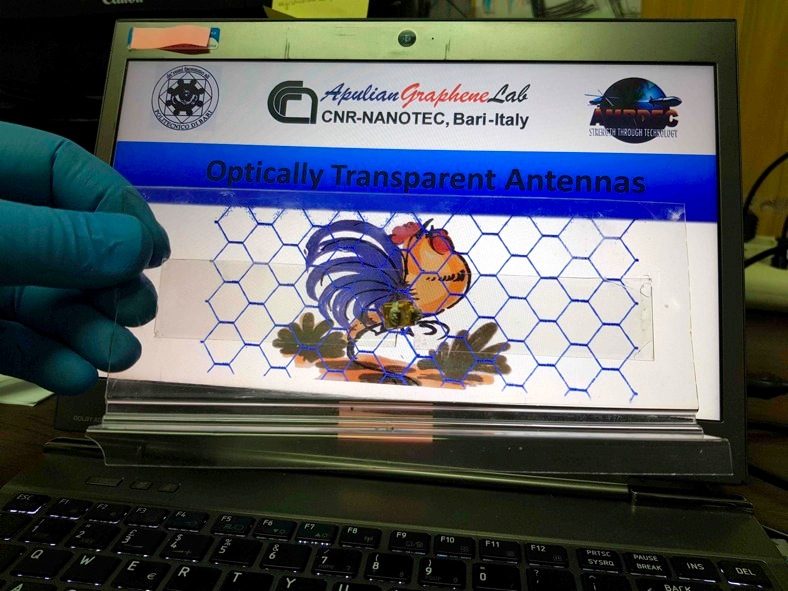
- Marco Grande, Giuseppe Valerio Bianco, Dario Laneve, Pio Capezzuto, Vincenzo Petruzzelli, Michael Scalora, Francesco Prudenzano, Giovanni Bruno, Antonella D’Orazio, “Optically transparent wideband CVD graphene-based microwave antennas”, Applied Physics Letters, vol. 112, no. 25, 2018.
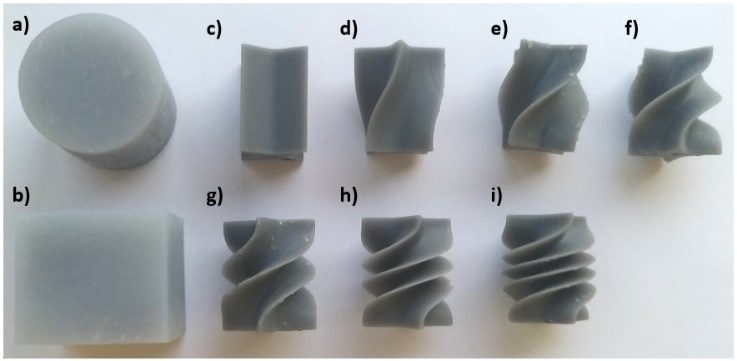
- Luigi Melchiorre, Ilaria Marasco, Giovanni Niro, Vito Basile, Valeria Marrocco, Antonella D’orazio, Marco Grande, “Bio-inspired dielectric resonator antenna for wideband sub-6 GHz range”, Applied Sciences Switzerland, vol. 10, no. 24, 2020.
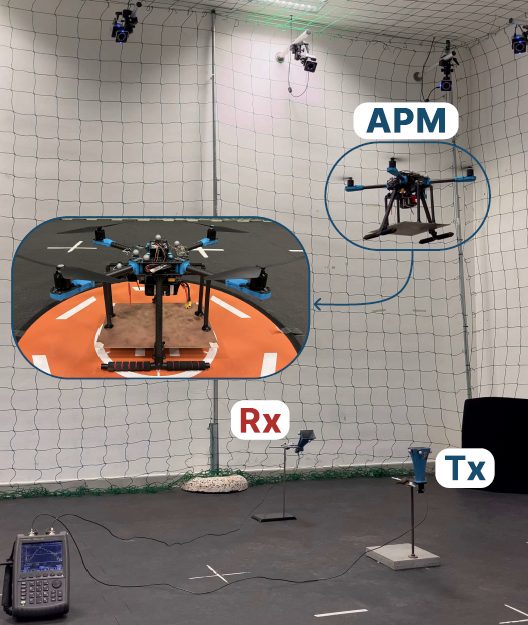
- Enrico Boffetti, Ilaria Marasco, Carla Cantore, Giovanni Magno, Giuseppe Piro, Antonella D’Orazio, Luigi Alfredo Grieco, Gennaro Boggia, “In-Flight Pose and Electromagnetic Experimental Characterization of UAV-Mounted Metasurfaces for Next-Generation Indoor Wireless Systems”, IEEE Internet of Things Journal, vol. 12, no. 20, 2025.
- Graphene RF devices – optically transparent antennas, absorbers and frequency selective surfaces.
- Dielectric resonator and wearable antennas – bio-inspired and super-shaped DRAs fabricated by 3D printing.
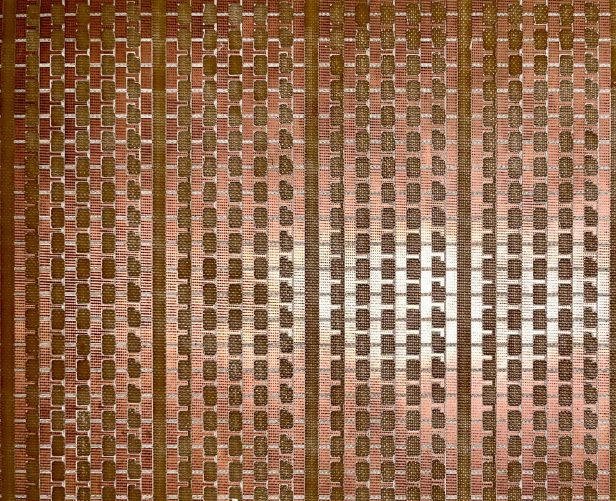
- RIS and metasurfaces – X-band design, genetic optimization and in-flight characterization of UAV-mounted metasurfaces.
- Non-terrestrial networks – satellite far-field emulation and optical feeder links.
EMI shielding & physical layer security
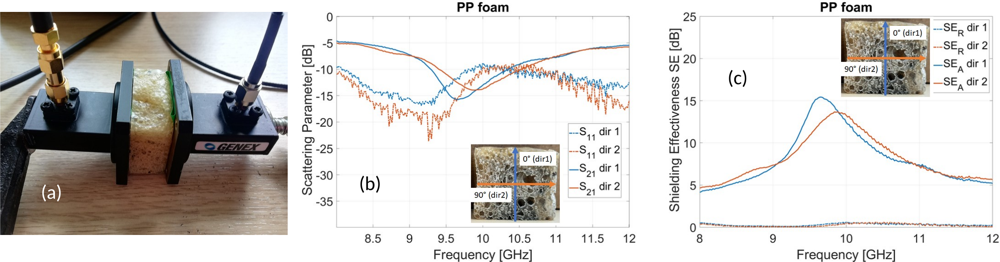
Design and optimization of devices and systems for electromagnetic interference (EMI) mitigation, including sustainable composite materials for EMI shielding, and study of radio channels and antennas for physical layer security.

Related publications
- Valeria Marrocco, Rossella Surace, Elisabetta Brandonisio, Ilaria Marasco, Claudia Pagano, Cinzia Tonetti, Vito Errico, Giovanna Calò, Sabina L. Campanelli, Irene Fassi, “Investigating EMI shielding performance of recycled polypropylene (PP) composite foams with reused metal powders”, Materials and Design, vol. 254, 2025.
- Alessandro Santorsola, Marco Zoli, Andre Noll Barreto, Vincenzo Petruzzelli, Giovanna Calo, “Effect of Radio Channel and Antennas on Physical-Layer-Security Key Exchange”, IEEE Access, vol. 9, 2021.
- EMI shielding – recycled and bio-based composite materials and foams, characterized in the X band.
- Physical layer security – effect of radio channels, antennas and RIS on secret-key generation.
Computational electromagnetics
Electromagnetic modelling is at the core of all our activities, from microwave to optical frequencies. The group has extensive expertise in the main full-wave and modal numerical methods – FDTD, FEM, RCWA, PWEM, BPM and others – as well as in multiphysics simulations, and combines commercial, open-source and in-house codes depending on the problem at hand.
Earlier research lines
Over more than twenty years the group has also worked on rare-earth-doped lasers and amplifiers, second- and third-order nonlinear processes for all-optical networks, extraordinary optical transmission and plasmonic structures for photovoltaics, and piezoelectric (FBAR and SAW) resonators for microwave filters and sensors.