
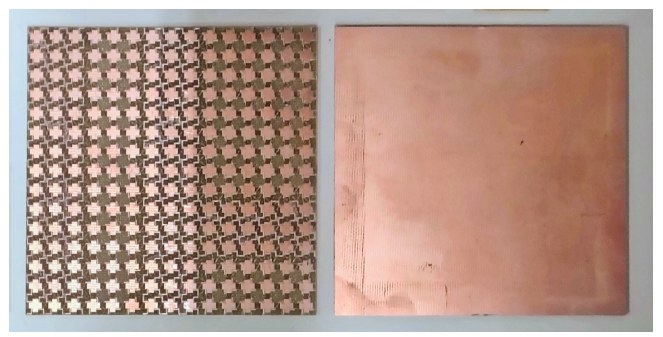
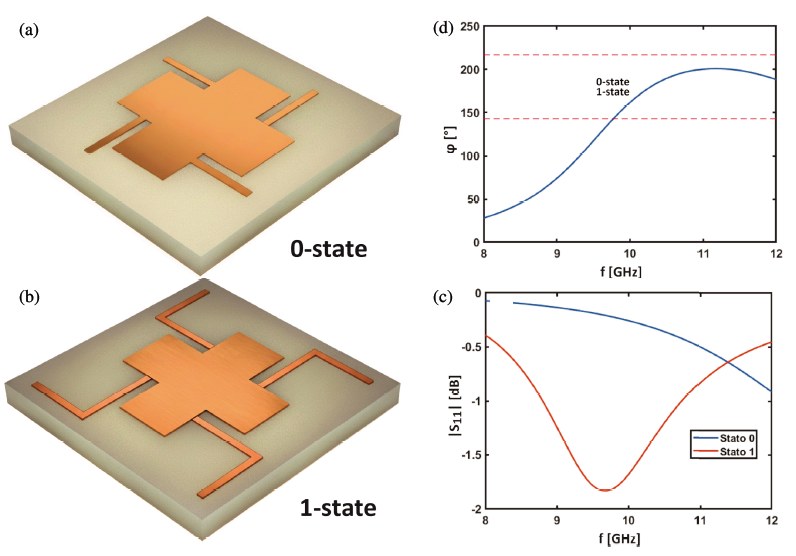
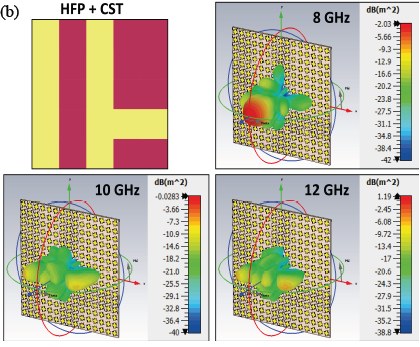
Reducing the radar cross-section (RCS), that is how “visible” an object is to radar, matters for aircraft, ships, drones and satellites, but also for civil and dual-use systems. Coding metasurfaces, flat panels made of tiny cells that reflect with a phase of 0° or 180°, can scatter radar waves in many directions instead of back to the radar. Designing them is demanding, however: finding the best arrangement of cells requires many slow full-wave simulations.
What is new
- A hybrid genetic algorithm in two stages: a fast analytical pre-optimization (Huygens–Fresnel principle) followed by refinement with full-wave simulations.
- A new “spiralling cross” unit cell, whose meandered delay lines give extra freedom to tune the response and support intermediate phase states beyond the classic 1-bit scheme.
Key results
- The hybrid approach cuts computation time by about 25% compared with full-wave-only optimization, with comparable performance.
- It avoids the trivial checkerboard layouts produced by purely analytical design, which ignores coupling between cells.
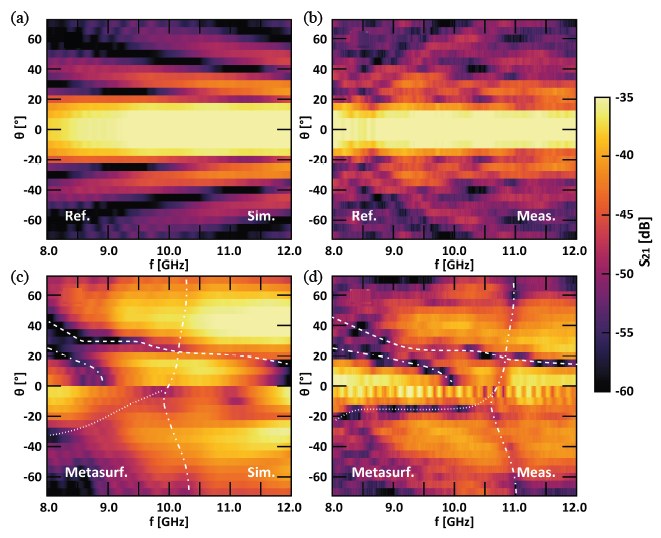
- The optimized metasurface reaches a maximum RCS reduction of about 21 dB near 10 GHz and about 12 dB on average over 9–12 GHz.
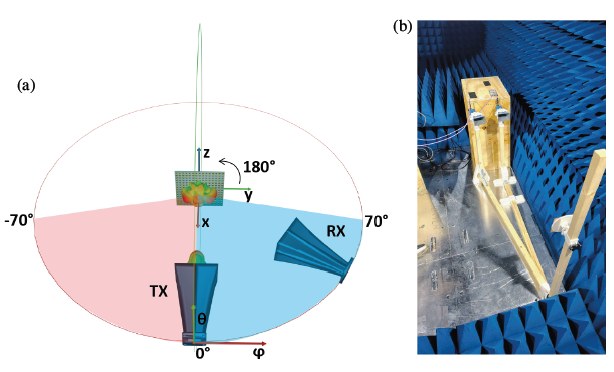
- A prototype was fabricated in our lab and measured in an anechoic chamber, in good agreement with simulations.
Impact & outlook
The method strikes a good balance between accuracy and computational cost and scales to much larger metasurfaces. Next steps include multi-bit coding, which could widen the bandwidth and lead to programmable metasurfaces for stealth, electromagnetic compatibility and wireless applications.
Reference: S. Marzullo, I. Marasco, A. D’Orazio, G. Magno, “Hybrid Genetic Optimization of Metasurfaces for Scattering Control: X-Band Design and Experimental Validation,” Progress In Electromagnetics Research 185, 97–109 (2026). doi:10.2528/PIER26021001