
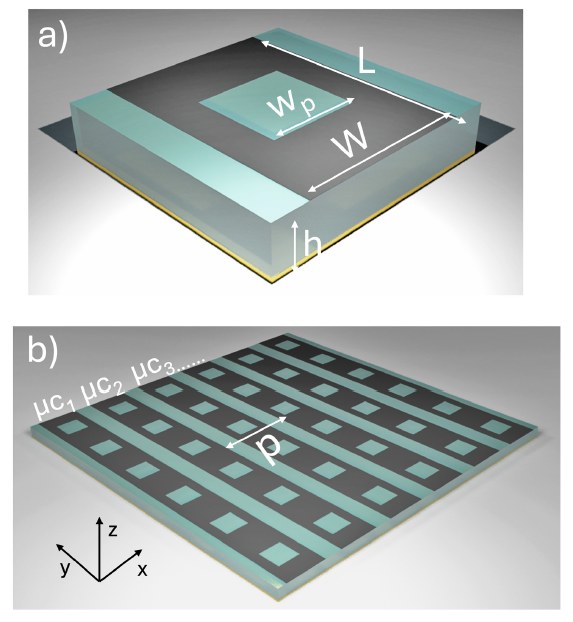
Future 6G networks will use terahertz (THz) frequencies to reach very high data rates, but THz signals are easily blocked and absorbed. Reconfigurable intelligent surfaces (RIS), a kind of programmable “smart mirror”, can redirect the signal around obstacles. Making them transparent would allow them to be integrated into windows, glass walls or screens.
What is new
- A transparent RIS made of patterned graphene on sapphire, working between 1 and 6 THz and tuned through the graphene chemical potential.
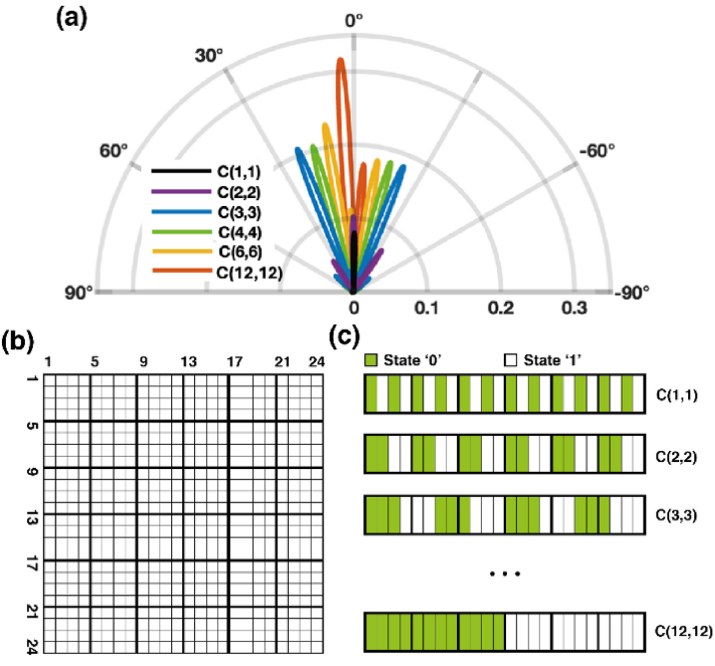
- Two ways of programming it: a “digital” approach, which switches cells between two states with equal amplitude and 180° phase difference (1-bit coding), and an “analogical” approach, which steers the beam to virtually any angle by tuning the geometry of the graphene aperture.
Key results
- A finite 24×24-cell RIS was fully simulated and compared with the ideal array-factor model used in much of the literature.
- The full analysis reveals beam asymmetries linked to the coding and a reduction in reflected power due to losses and mutual coupling between cells: effects that idealized models overlook.
Impact & outlook
A realistic design is essential to bring RIS from theory to real 6G systems. Graphene metasurfaces, with their ability to modulate signals in space and time, open the way to adaptive wireless technologies and advanced signal processing. The work was carried out with CNR-NANOTEC within the RESTART programme (NRRP, NextGenerationEU).
Reference: I. Marasco, C. Cantore, G. V. Bianco, G. Bruno, A. D’Orazio, G. Magno, “Transparent Graphene-Based RIS for 6G Communications in the THz Spectrum,” IEEE Open Journal of Antennas and Propagation 6(1), 193 (2025). doi:10.1109/OJAP.2024.3487793